You have an important task to do. Instead of starting, you open social media, pick up some minor job or decide that now is the right time to clean the house. That is procrastination, not laziness.
What is procrastination?
Procrastination means avoiding an important task. You may still do something else, perhaps even something productive, while making no progress on the job that matters.
Why do we avoid tasks?
When you’re procrastinating, the task in front of you usually feels like it is:
- Difficult: It requires skills or knowledge you’re not confident about
- Big: It feels overwhelming and you don’t know where to start
- Unpleasant: It’s boring, annoying, or simply something you don’t enjoy
Your brain tends to choose an easier or more enjoyable activity. A metaphor from physics helps explain why.
Newton’s first law of productivity
Do you remember Newton’s first law of motion from high school?
An object remains at rest or continues to move at a constant velocity, unless acted upon by an external force.
The metaphor fits procrastination: while avoiding a task you are at rest, and while working you are in motion. Staying in motion is much easier than getting into motion.
Think about writing a paper. The hardest part isn’t writing page five. It’s writing the very first sentence. Once you’ve started, momentum builds and continuing feels almost automatic.
Why starting matters
To get past procrastination, you have to start and then keep going. Newton’s first law gives us the analogy: once you are moving, you tend to keep moving.
But that naturally raises the question: if starting is so important, why is it so hard?
The chemistry of procrastination
The Arrhenius equation describes reaction rates in chemistry. A reaction needs enough energy to begin. That minimum is called activation energy.
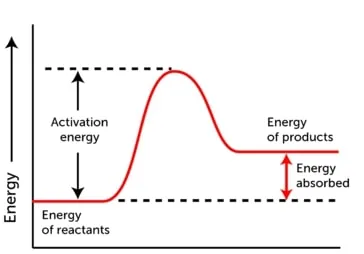
The energy barrier between procrastinating and working: activation energy.
On the left are the reactants: you on the couch, scrolling on your phone and postponing the task. This is a relatively low-energy state. You are at rest.
On the right, you see the products: that’s you actively working. This is a higher-energy state because you’re now using mental and physical energy. You’re focused, thinking, creating, solving problems. All of that costs continuous energy.
To move from that low-energy state to the higher-energy state of working, you first have to cross the peak in the middle. That peak is the activation energy, the initial burst of energy needed to start.
That is why starting can feel so heavy. In this analogy, you are climbing an energy hill: pushing through the initial resistance until you reach a working state.
Opening a laptop to face a blank document takes activation energy. So does getting off the couch to go to the gym or making a difficult call to a demanding client.
The bigger a task feels, the higher that activation-energy peak becomes. The more tired you are, the less energy you have to get over it.
In this model, laziness is not the issue and nothing is wrong with you. Every task has an activation-energy barrier, and procrastination happens when your available energy is lower than the energy required to start.
The solution: energy management
If procrastination is about activation energy, there are two ways to solve it:
- Increase your available energy so you have more fuel to overcome the barrier.
- Lower the required activation energy so the barrier becomes smaller.
Increase your available energy
Available energy is your physical and mental capacity to act. You can increase it in several ways.
Build your discipline
Discipline is like a muscle: the more consciously you use it, the stronger it becomes. Training it regularly is more useful than saving it for the tasks you already avoid.
Regular practice can take several forms.
Exercise
Of these methods, exercise may be the most effective way to train discipline. During the last repetition of a workout, continuing despite wanting to stop trains you to act through discomfort. You replace “I don’t want to” with “I’m doing it anyway,” the same response you need when starting a difficult task.
Going to the gym when you would rather stay home is practice in starting. Finishing a workout instead of quitting early is practice in moving through resistance. Both carry over to work tasks.
You do not have to become a fitness fanatic. Even 20 minutes of challenging movement builds this capacity if you do it consistently and move slightly beyond your comfort zone.
Cold showers
A cold shower is a highly effective exercise in accepting discomfort without being in danger. Each time you step into cold water while your brain says “no,” you train the same neural pathway you use to start a difficult task.
The thought telling you to avoid the cold water also appears when you face a difficult email or project. Overriding it in a low-risk situation builds the ability to do so when the outcome matters.
Start with 30 seconds of cold water at the end of a normal shower. It is a short exercise in doing the uncomfortable thing anyway.
Take responsibility
Committing to someone else creates external pressure that helps you overcome activation energy. People are often better at completing work for others than for themselves.
Join a study group where others expect you to have prepared. Tell a friend you’ll send them your draft by Friday. Schedule a meeting that requires preparation. You don’t want to let the other person down, which creates extra motivation to act.
Waste less discipline
Discipline is a finite resource. Research shows that your willpower decreases throughout the day as you make decisions and resist temptations. This is called decision fatigue.
Every time you decide what to wear, what to eat, whether to check your phone, or which task to do next, you draw from your discipline reserve. By the time you reach that important, difficult task, most of your discipline may already be gone, spent on meaningless decisions.
Many people start their day by unlocking their smartphone and choosing which app to open first. Then they read the overnight news, constantly deciding whether an article is worth opening. Then they scroll endlessly through social media, subconsciously deciding for each post whether it deserves attention. By the time they think about real work, their discipline tank is already half empty.
Do the important work first and leave the minor tasks until later. By then, you may no longer feel the need to do them at all.
Turn off notifications
Every notification creates a small decision: check it or ignore it. Ignoring it still uses discipline; checking it breaks your focus and requires more effort to return. Fully regaining that focus can take at least 20 minutes.
Turn off non-essential notifications instead of silencing them. Check messages when you choose, not whenever someone else interrupts you. That can preserve a substantial amount of mental energy throughout the day.
Reduce decision fatigue
Steve Jobs wore the same outfit every day. Obama did the same during his presidency, and Mark Zuckerberg still does. They avoided spending willpower on what to wear.
You don’t have to go that far, but consider:
- Wear clothes that don’t require thinking about whether the combination works
- Eat simple but healthy meals without overthinking every choice
- Build routines so actions happen on autopilot
Routines reduce the number of choices you have to make. You do not debate whether to brush your teeth; it simply happens. More routines leave more discipline for important work.
If every morning you decide whether to exercise, what to eat, what to wear and which task to start, you make dozens of choices before doing any real work. Decide once instead: “I work out at 7, eat eggs and steak, wear my Monday outfit, and start with the hardest task.” One decision replaces many later ones.
Do important tasks first
For most people, the discipline reserve is fullest in the morning. Use that time for the hardest task instead of email, social media or easy work.
Email feels productive, but it’s other people’s priorities invading your day. Social media feels like a quick break, but it’s an attention trap that drains focus. Save these for after you’ve done what matters. If your discipline is already spent on important work, it doesn’t matter if you waste the leftovers on trivialities.
Rest properly
To have more energy for work, you also need to stop working. Rest is a condition for productivity.
Sleep well
Sleep is the foundation for the rest. Sleep deprivation makes you tired and impairs the prefrontal cortex, the part of your brain involved in overriding impulses and starting difficult tasks. A lack of sleep therefore makes activation energy harder to overcome.
You cannot compensate for sleep deprivation with discipline. If you consistently sleep less than 7 to 8 hours, overcoming procrastination becomes nearly impossible: the activation energy remains high while your available energy stays low.
Treat sleep like fuel. You would not drive across the country on an empty tank, and difficult work also becomes harder when you have not slept enough.
Spend time in nature
Solid research links time in natural environments to lower cortisol, less mental fatigue and restored attention. Even 20 minutes in a park makes a measurable difference to your ability to focus afterwards.
A park or tree-lined street is enough. Even a view of nature through a window has measurable effects.
Meditate
Meditation trains you to notice when your attention drifts and bring it back. Focused work uses the same skill.
If you meditate for 10 minutes, your mind will wander dozens of times. Each time you notice and return to your breath, you strengthen your attention control. This directly translates to better focus while working.
Start with 5 to 10 minutes a day and use an app if that helps. The aim is to practise sustained attention, not to become “good” at meditation.
Be creative
Not every activity drains energy. Painting, making music, gardening, building something or cooking can put you into flow and restore energy.
Creative activities use different mental systems from demanding cognitive work. After hours of coding or data analysis, 30 minutes of painting helps you recover instead of adding to your mental fatigue.
Choose a creative activity that holds your attention without draining your discipline. It can be woodworking, cooking or gardening; it does not have to be art.
Eat nourishing food
Your brain is about 2% of your body weight but consumes roughly 20% of your calories. It’s an energy-hungry organ, and its performance depends heavily on what you feed it.
A typical modern eating pattern looks like this:
- Sugary breakfast → blood sugar spike → insulin response → crash by 10 a.m.
- Skipping lunch or eating simple carbs → another spike and crash
- Energy drink for “energy” → caffeine and sugar mask fatigue, then worsen it
- By the time you need to do focused work, your energy is on a roller coaster
The alternative:
- Eggs and meat for breakfast → stable blood sugar for hours
- Animal protein and fats at each meal → consistent energy without crashes
- Proper hydration → better cognitive function
- Unprocessed food (meat, eggs, dairy, fruit) → sustained energy instead of spikes
You don’t need a perfect diet. You need a stable one. Animal protein, healthy fats from meat and dairy, fruit for quick energy, and enough water.
Lower activation energy: use a catalyst
Another way to overcome the energy barrier is to lower the barrier itself. In chemistry, a catalyst lowers the activation energy required for a reaction, without being consumed in the process.
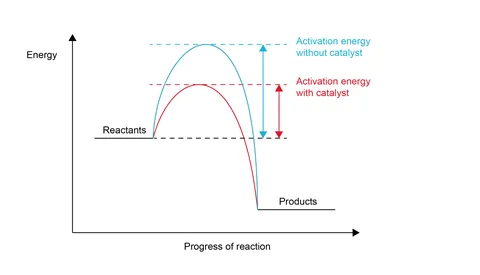
A catalyst lowers the energy barrier, making the same reaction easier to start.
The catalyst creates a route that needs less energy to begin. The starting point (reactants) and end point (products) remain the same, while the peak in the middle, the activation-energy barrier, is much lower.
For a task, a catalyst is anything that lowers the effort needed to start.
Break tasks into smaller tasks
Of these catalysts, breaking a task down is the most effective.
When you look at “write a report,” your brain sees a huge, undefined task. How long will it take? What if you get stuck? What if it’s not good enough? All that uncertainty adds to activation energy. The task feels like climbing a mountain.
But when you look at “write one sentence,” your brain sees something manageable. One sentence takes 30 seconds. You know you can do it. You can see the end from the start. Activation energy plummets.
- Instead of
write a paper(high activation energy), make itwrite one sentence(low activation energy). - Instead of
clean the house(overwhelming), make itclean the counter for 2 minutes(doable). - Instead of
study for the exam(vague and huge), make itread and summarize one page(specific and small).
Once you write one sentence, the second is easier. Why? Because you’re already in motion. You’ve crossed the activation-energy barrier. The document is open, your thoughts are organized, your fingers are on the keyboard. Writing the next sentence costs almost no additional energy.
This is Newton’s law in action. Starting from rest requires huge energy. Continuing motion requires much less. By making the first step ridiculously small, you make starting possible. Then momentum carries you further than you planned.
You write one sentence, notice a typo and fix it. Then you add a paragraph and realise you need to check a source. Thirty minutes later, you have done substantial work because you lowered the barrier enough to start.
Lower your expectations
Perfectionism is one of the most insidious forms of procrastination. It hides behind high standards while raising the activation energy so far that you never start.
If your task is “write a perfect introduction,” activation energy is enormous. Your brain knows this is impossible on the first attempt, so it resists starting. The gap between where you are (nothing written) and where you need to be (perfection) feels unbridgeable.
If your task is “write a messy first draft that no one will ever see,” the barrier is much lower. A messy draft is easy. Anyone can write badly. Activation energy becomes minimal.
You can’t edit a blank page. A terrible first draft is infinitely better than a perfect unwritten one, because you can improve what exists. You can’t improve what doesn’t exist.
Give yourself explicit permission to produce garbage. Tell yourself: “I’m going to write the worst introduction possible, just to get words on the page.” This removes the psychological weight. You’re no longer climbing a mountain, you’re just taking a step.
Many of the greatest writers in history produced terrible first drafts.
“The first draft of anything is shit.” (Ernest Hemingway)
Creation happens in two distinct phases: generating and refining. Perfectionism tries to do both at once. That’s like trying to paint while also cleaning your brushes. Separate them. Generate without judgment first. Refine later.
Think about your why
This strategy works differently. It doesn’t directly lower the activation-energy barrier, but it increases your willingness to climb it. When the barrier is truly high and can’t be lowered further, thinking about your purpose helps you find the energy to push through.
Why are you writing this paper? Not “because I have to”, that’s stressful, not motivating. Maybe you’re genuinely curious about the topic. Maybe this paper is part of an education that leads to a career you want. Maybe mastering this skill makes you better at something you care about.
Why do you exercise? Not “because I have to.” Maybe because you want energy to play with your kids. Maybe because you remember how good you felt when you were in shape. Maybe because you’re training for something specific.
Why do you call potential clients? Not “because I must.” Maybe because each call brings you closer to financial independence. Maybe because you’re building something meaningful. Maybe because you’re developing a skill you’ll use for decades.
Connect the task to something that genuinely matters to you. This doesn’t make starting easy, but it makes you willing to do the hard thing anyway. It’s the difference between “I don’t want to do this” and “I don’t want to do this, but I’ll do it anyway because it matters.”
Discipline and motivation
Discipline gets you started; motivation keeps you going. People often wait until they “feel motivated” before beginning, but in this model action creates motivation.
You need discipline to overcome activation energy. This is a conscious, often uncomfortable application of willpower. You push yourself over the initial hill even when you don’t feel like it. This part is always hard. There’s no way around it.
Once you are moving, you see progress and the task becomes concrete instead of abstract. Ideas start to flow, problems get solved and momentum builds. Discipline gives way to motivation because you are now interested in continuing.
Instead of trying to summon motivation, use discipline to begin. The motivation follows from the action.
You may recognise the experience of dreading a task, forcing yourself to start and realising 1.5 hours later that you are fully engaged. The motivation arrived after the start, not before it.
The flow state
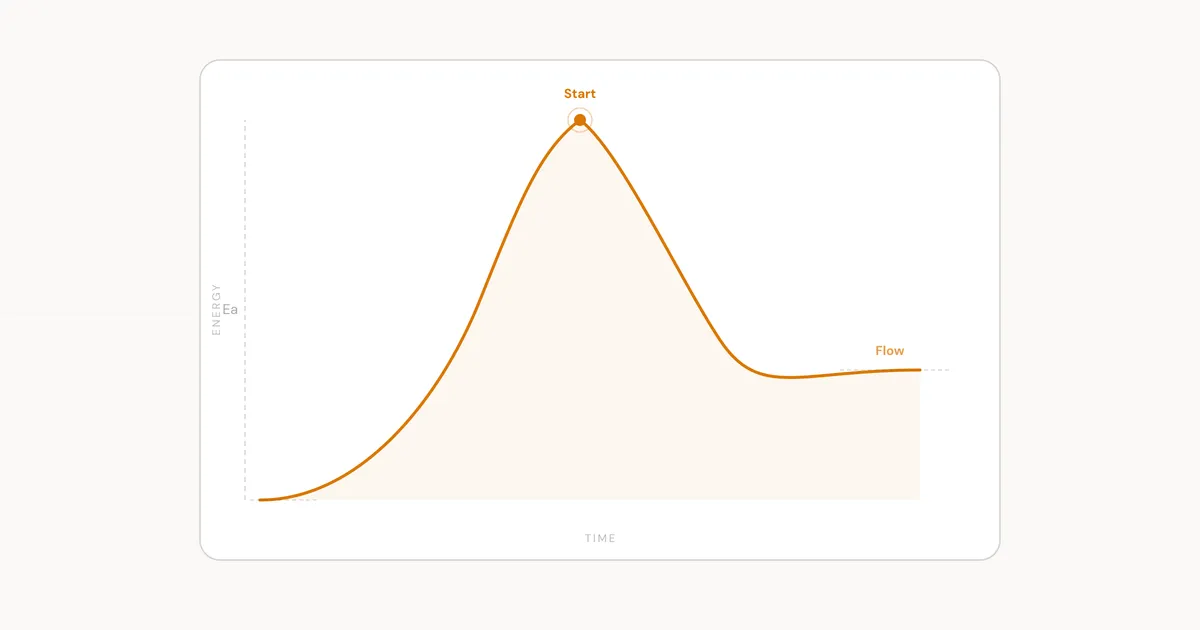
If you keep going, you may enter flow: complete focus on one activity, with little sense of time or distraction.
In flow, you no longer fight to stay focused because the work holds your attention. Hours can feel like minutes, and the task takes less effort than you expected.
In our chemical analogy: once you’ve climbed over the activation-energy peak and reached the “product” state (active work), maintaining that state requires far less energy than the initial climb. You’re in a higher-energy state, but staying there is easy because momentum carries you.
You can only reach flow after starting. It does not happen while you procrastinate or think about beginning, but after you push through the first resistance.
These energy-management strategies make starting easier and create the conditions in which flow can occur.
A practical summary
In this model, procrastination is an energy-management problem rather than a character flaw. The task asks for more activation energy than you currently have available.
There are four parts to the response:
- Take care of your available energy through discipline, proper rest and stable nutrition.
- Lower the threshold by making the first step very small, allowing an imperfect first attempt and connecting the task to a reason that matters to you.
- Start despite the discomfort. Discipline only has to carry you through the first few minutes before momentum and motivation can take over.
- Keep going and give that momentum a chance to turn into flow.
You do not need to maintain peak motivation for hours. Choose the smallest useful first step and begin there.